
How to Make Fresh Orange Juice (Best Oranges + 4 Easy Methods)

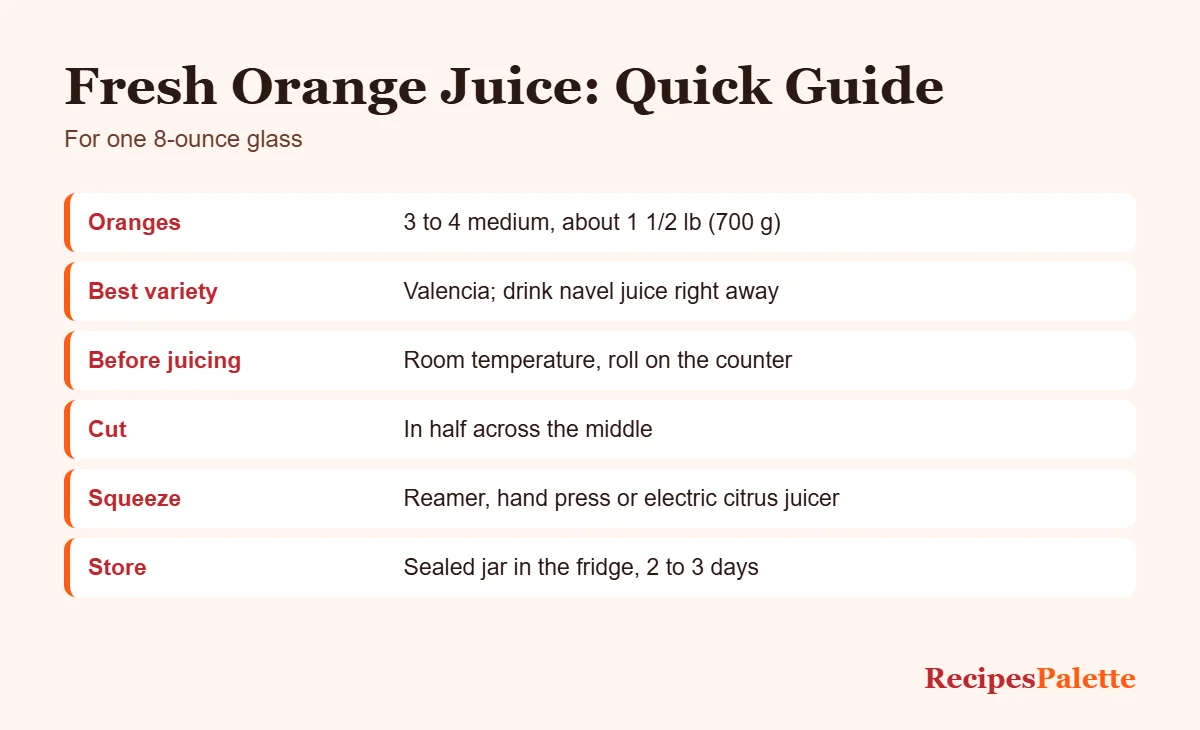
To make fresh orange juice, roll 3 to 4 room-temperature oranges on the counter, cut them in half across the middle, and squeeze each half on a reamer or citrus press. Strain out seeds, keep as much pulp as you like, and drink it soon. Three to four medium oranges make one 8-ounce (240 ml) glass. Valencia oranges give the sweetest, juiciest results; navel juice is best drunk straight away.
Freshly squeezed orange juice tastes brighter and more complex than almost anything in a carton. It takes about five minutes and needs very little equipment. This guide covers the best oranges to buy, four ways to juice them, how to get the most juice from every fruit, and how long fresh orange juice keeps.
What You Need
- 3 to 4 medium juicing oranges per 8-ounce glass (about 1 1/2 pounds / 700 g)
- A sharp knife and cutting board
- A citrus reamer, handheld press, electric citrus juicer or regular juicer
- A small fine sieve (optional, for seeds and extra pulp)
- A jug or glass
The Best Oranges for Juice
| Variety | Typical US season | Juice flavor | Notes |
|---|---|---|---|
| Valencia | About March to September | Sweet, juicy, classic | The top juicing orange; may have a few seeds |
| Navel | About November to May | Sweet and fresh at first | Can turn bitter if it sits; drink right away |
| Cara Cara | About December to April | Sweet, low acid, berry notes | Pink-red flesh, pretty juice |
| Blood orange | About December to April | Raspberry-like, slightly tart | Deep red juice; great mixed with regular oranges |
| Hamlin and Pineapple oranges | About October to March | Mild and sweet | Common in Florida juice |
Why navel juice turns bitter: navel oranges contain a compound that slowly turns bitter after the fruit is squeezed. Fresh navel juice tastes great for the first 20 to 30 minutes, then gets noticeably more bitter. Squeeze navels just before drinking, or mix them with Valencia oranges.
How to pick good oranges
- Choose fruit that feels heavy for its size; that means more juice.
- Look for smooth, thin, slightly glossy skin. Thick, bumpy skin often means less juice.
- Skip fruit with soft, moldy or shriveled spots.
- Green patches on Valencias are fine. They can “regreen” on the tree in warm weather without affecting the flavor.
Method 1: Hand Reamer
- Wash the oranges under running water and dry them.
- Roll each orange firmly on the counter under your palm for 10 to 15 seconds.
- Cut in half across the middle (not through the stem end).
- Hold a half over a bowl and twist the reamer into the flesh, turning the fruit back and forth.
- Strain out the seeds and pour.
A wooden or plastic reamer costs very little and is perfect for one or two glasses.
Method 2: Handheld Squeezer or Lever Press
Place an orange half cut side down in a hinged squeezer (or in the cup of a lever press) and press firmly. These give more juice than a reamer with less effort, and the strainer catches seeds. Large oranges may not fit small “lemon size” squeezers, so check the bowl size before buying.
Method 3: Electric Citrus Juicer
Press each half onto the spinning cone and let the motor do the work. This is the best choice if you make orange juice for the family every morning. Many models let you adjust how much pulp goes into the juice. We compare the options in manual vs electric citrus juicer.
Method 4: Regular Juicer or Blender
You can juice peeled oranges in a centrifugal or slow juicer. Remove all the peel and most of the white pith first, because both taste bitter and the peel oils can upset some juicers. In a blender, blend peeled, seeded segments for about 15 seconds, then strain. These methods work but are more effort than a citrus juicer for plain orange juice. They make sense when you are adding other produce, as in orange carrot juice. If you are deciding what to buy, see how to choose a juicer.
How to Get More Juice From Each Orange
- Juice at room temperature. Cold oranges give noticeably less juice. Take them out of the fridge an hour before, or warm them in a bowl of warm water for a few minutes.
- Roll before cutting. Pressing and rolling breaks the juice cells inside.
- Cut across the middle, not from stem to base. This exposes all the segments.
- Twist and press. Turn the fruit as you press so you reach every segment.
- Do not press the peel too hard. Squeezing the last bit out of the skin adds bitter oils.
Pulp or No Pulp?
It is personal taste. For no pulp, strain the juice through a fine sieve. For some pulp, use a coarse strainer or the strainer on your press. For lots of pulp, scrape the flesh from the squeezed halves with a spoon and stir it in. Pulp contains some of the fruit’s fiber, while strained juice is smoother.
Flavor Ideas
- Orange + carrot: 3 oranges and 3 carrots in a juicer. Sweet and sunny.
- Orange + blood orange: half and half for a pink sunrise color.
- Orange + ginger: stir in a little freshly grated ginger juice.
- Orange + pineapple: tropical and sweet.
- Orange + pomegranate: tart and deep red. See how to juice a pomegranate.
- Orange + mint sparkler: half orange juice, half sparkling water, a few mint leaves.
Our carrot ginger juice and list of juice combinations have more ideas.
How Long Does Fresh Orange Juice Last?
- Counter: no more than 2 hours.
- Fridge: about 2 to 3 days in a sealed container at 40°F (4°C) or colder. It tastes best on day one. Navel juice is best drunk within the hour.
- Freezer: several months in freezer-safe containers with about 1 inch of space at the top, or in ice cube trays.
Fill the jar near the top to limit air, and shake before pouring. Read more in how long fresh juice lasts. Fresh-squeezed juice is unpasteurized, so wash fruit before cutting; our juicing safety tips explain why that matters and who should choose pasteurized juice.
How Much Juice Will You Get?
Yield depends on the variety, the size of the fruit and your method, but this is a useful shopping guide for medium oranges squeezed on a citrus press:
| Juice wanted | Medium oranges | Approximate weight |
|---|---|---|
| 1/2 cup (4 oz) | 2 | About 3/4 lb (350 g) |
| 1 cup (8 oz) | 3 to 4 | About 1 1/2 lb (700 g) |
| 4 cups (1 quart) | 12 to 16 | About 6 lb (2.7 kg) |
A bag of oranges marked “juice oranges” is often the best value, because the fruit is chosen for juiciness rather than looks.
Common Orange Juice Mistakes
- Squeezing cold fruit straight from the fridge. You lose a lot of juice.
- Using a reamer that is too small. Large oranges need a large cone or press.
- Making navel juice too far ahead. It turns bitter.
- Leaving seeds in. Crushed seeds add bitterness; strain them out.
What to Do With the Peels
Before squeezing, zest a few oranges and freeze the zest for baking. After squeezing, the peels can be candied, dried for tea, simmered with cinnamon to scent the kitchen, or composted.
Frequently Asked Questions
How many oranges does it take to make a cup of juice?
About 3 to 4 medium oranges make 1 cup (8 oz / 240 ml). Very juicy Valencias may need only 2 to 3.
Why does my fresh orange juice taste bitter?
Usually because navel oranges were used and the juice sat for a while, or because peel and pith were pressed too hard. Use Valencias for juice that sits, and drink navel juice right away.
Should I peel oranges before juicing?
Not for a reamer or citrus press; just cut them in half. Peel them fully for a regular juicer or blender.
Can I make orange juice the night before?
Yes, with Valencia or Cara Cara oranges. Keep it in a full, sealed glass jar in the fridge. Navel juice is likely to taste bitter by morning.
Is fresh orange juice better than store-bought?
It usually tastes brighter and fresher. Store-bought juice is pasteurized, so it keeps longer and is the safer choice for young children, pregnant people and anyone with a weakened immune system.
How do I get more juice from oranges?
Juice them at room temperature, roll them first, cut across the middle and twist as you press.
Buy heavy, thin-skinned oranges, let them warm to room temperature, roll, halve and squeeze. A glass of fresh orange juice is one of the simplest kitchen luxuries there is.